A chime clock indicates the quarter-hours by playing a short melody, usually on chime rods, in addition to striking the hours.
Many chime clocks from the 1960s and later have movements made by Hermle in the Black Forest of Germany. These movements can usually be replaced more cheaply than repaired. You may e-mail a photo of the back of the movement to me, and I'll tell you if it we can replace it.
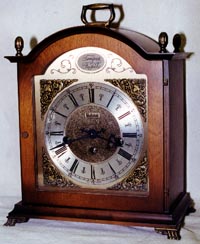
Typically, $600 to $900 for movement replacement (where applicable). Includes many Howard Miller, Ridgeway, Seth Thomas and Hamilton clocks (those with Hermle movements.) Two-year warranty.
About $50 Shipping & insurance (continental US).
Movements with extra features such as calendar will cost more.
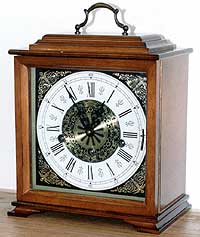
Westminster Chime Hermle Movement: about $600 plus about $50 shipping and handling (in the U.S.)
Triple Chime Hermle Movement: about $675 plus about $50 shipping and handling (in the U.S.)
To repair the original movement will cost more than the replacement movement, and is not recommended.
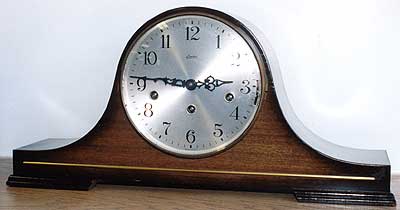
Westminster Chime Hermle Movement: about $600 plus about $60 shipping and handling (in the U.S.)
Triple Chime Hermle Movement: about $675 plus about $60 shipping and handling (in the U.S.)
To repair the original movement will cost more than the replacement movement, and is not recommended.
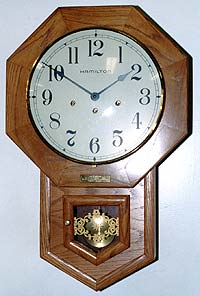
Westminster Chime Hermle Movement: about $650 plus about $75 shipping and handling (in the U.S.)
To repair the original movement will cost more than the replacement movement, and is not recommended.
We can do a movement replacement quickly (if the movment is in stock). Please contact us about sending a clock for repair.
Please send the key so I can check how well it fits. I will replace it if it is worn out (I will return the original to you). Please let me know if you don't have a key.
Before packing the clock, remove the pendulum bob and wrap it and the key in bubble wrap. You will pack these outside of the wrapped clock. Gently tape the pendulum rod to the movement to prevent motion. Put padding around the hammers, gong or chime rods inside the clock to immobilize them. It is important that the chime rods inside be padded so they won’t vibrate during shipping (or they might break off).
Wrap the entire clock in enough layers of bubble wrap to be an least three (3) inches thick.
Use a strong box that gives at least 3 inches of space around the wrapped clock on ALL sides. Put a 3 inch layer of foam packing peanuts in the bottom of the box. Put in the wrapped clock, and fill the space firmly with peanuts. There must be at least three inches of packing peanuts on all sides of the wrapped clock, and above and below it. Put the wrapped key and pendulum bob in the box. There should be a slight pressure when closing the box to keep the clock from moving around. Packing peanuts provide the best support for the clock, I've seen broken glass lenses when paper filler was used instead.
Note: Many packing places today (such as The UPS Store) don't use packing peanuts anymore. In this case, wrap the clock in bubble wrap 4 to 6 inches thick; then 3 or 4 inches of firmly wadded brown paper will provide good padding between the wrapped clock and the box.

